

Financial literacy for an entrepreneur is the ability to read your own numbers, plan cash, borrow wisely and protect what you build, and then to use those numbers to make decisions. It is a business skill, not a personal-budgeting skill. The OECD’s framework defines it as the awareness, knowledge, skills, attitudes and behavior an owner-manager needs to make effective financial decisions to start, run and grow a business. Skills are learned fastest with a structured path and people who hold you to it, which is the idea behind the guidance and mentoring members receive through our membership.
TL;DR
- Financial literacy for founders means five things: knowing your numbers, managing cash, funding the business sensibly, borrowing within your means and protecting the downside.
- Start with three documents: a budget, a balance sheet and a cash-flow projection. Everything else builds on them.
- Before you borrow, check that your cash flow can cover the payments. Lenders commonly look for a debt-service coverage ratio of 1.25 or higher.
- Keep three to six months of operating costs in reserve.
- Skills stick when you practice them with mentors and peers, and when you tie money to purpose and ethics, not only to profit.
Table of Contents
- What financial literacy means when you run a business
- Why it matters: access to money and survival
- The numbers every owner should be able to read
- Budgeting and cash-flow management that hold up
- Funding and borrowing without overreaching
- Protecting what you build
- What a good financial education covers
- Financial skill as part of ethical leadership
- How membership supports your financial growth
- A 90-day plan to build the habit
- FAQ
- Sources
What financial literacy means when you run a business
Personal finance asks how much you earn, spend and save. Business finance asks harder questions. Will this month’s sales cover next month’s payroll? Can the company carry a loan? What does a price cut do to margin?
The OECD makes this distinction explicit: financial literacy for owners of small firms is specific to business issues, not personal finance. Its 2025 report on women entrepreneurs lists six practical skills that apply to any founder:
- Understand the costs and risks of business financial products.
- Identify sources of start-up financing.
- Anticipate future financial needs under different scenarios.
- Assess and respond to financial risks.
- Understand how finance providers decide, so you can become creditworthy.
- Use financial information to analyze performance and set up controls.
Notice what the list leaves out. It does not ask you to become an accountant. SCORE’s Financial Management Workbook makes the same point: the goal is to turn raw data into strategic clarity, so you steer growth on purpose instead of reacting to your bank balance.
Why it matters: access to money and survival
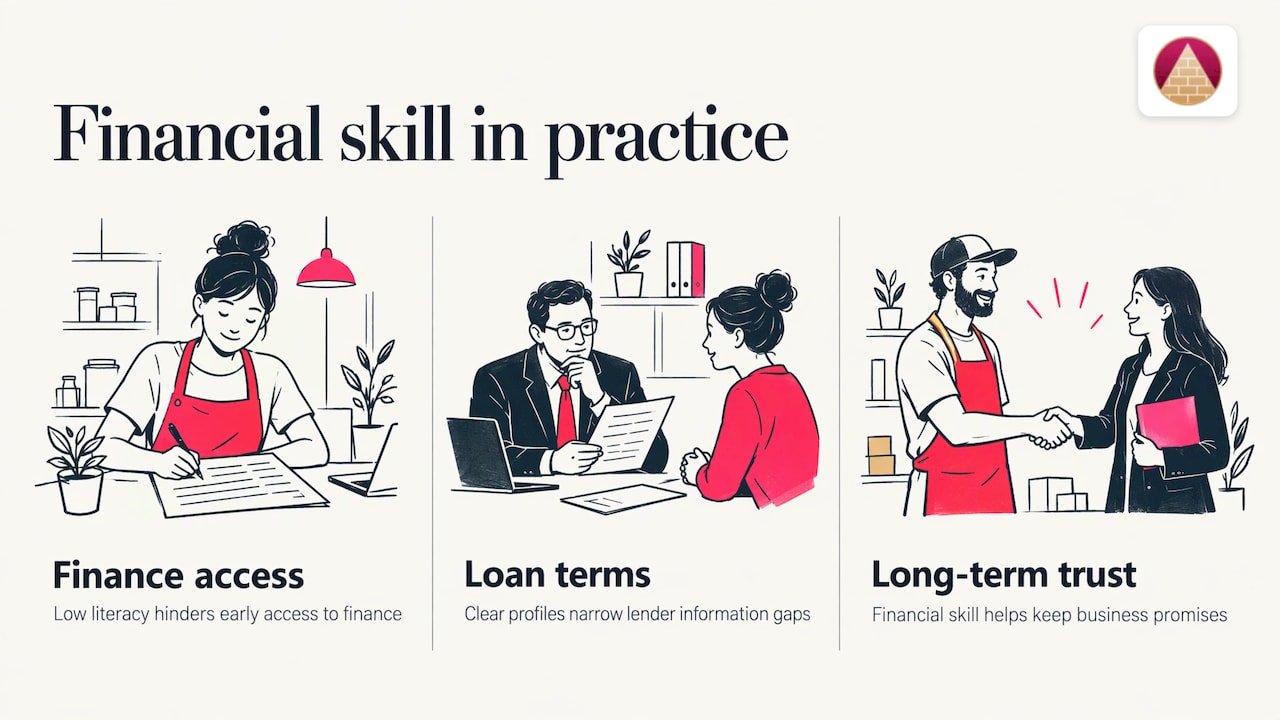
The case is practical. The OECD’s 2017 report on financial education for small firms finds that low financial literacy hinders access to finance in the early stages of a business and holds back sustainability and growth. Owners who understand their numbers can describe their financial profile clearly in a loan application, which narrows the information gap between borrower and lender. They are also better placed to make payments on time and stay within loan covenants, the conditions a lender attaches to a loan.
For a leader, there is a second reason. Money decides who your business can hire, which communities it can serve and how long it can keep its promises. Financial skill is what lets a business act on its values over the long term.
The numbers every owner should be able to read
The accounting equation
Every financial statement rests on one idea. As OpenStax’s entrepreneurship textbook explains, assets are what the business owns (cash, equipment, inventory, money customers owe it). Liabilities are debts that require future payment. Equity is the owner’s claim: what is left after debts are repaid. Assets equal liabilities plus equity, and if your records do not balance, something is wrong.
The balance sheet
The SBA calls the balance sheet the foundation of managing business finances. It is a snapshot of capital, assets, liabilities and equity at a moment in time, and it supports cash-flow projections for future years. Read it for one question: what do we own, what do we owe, and what is the difference?
The income statement and cash flow
The income statement shows revenue minus costs over a period. Cash flow shows when money actually moves. A business can be profitable on paper and still miss payroll because customers pay in 60 days while suppliers want payment in 30. This is why many founders say cash, not profit, pays the bills.
Ratios worth knowing
SCORE’s workbook names a short list of ratios: current ratio, quick ratio, debt-to-equity and net profit margin. You do not need all of them on day one. Net profit margin tells you how much of each sales dollar you keep. Debt-to-equity tells you how much of the business is financed by lenders versus owners.
Three terms for projections
OpenStax defines three planning terms in its startup projections chapter:
| Term | Meaning | Example |
|---|---|---|
| Run rate | Current performance scaled to a year | $10,000 a month in sales is a $120,000 annual run rate |
| Burn rate | Cash going out faster than it comes in | $2,000 a month in rent during a six-month renovation means $12,000 of financing needed |
| Breakeven point | Revenue that exactly covers costs | Below it you lose money, above it you profit |
If you remember one habit from this section, make it burn rate. It tells you how long you can operate before you need more money, and that is the most important number for a young company.
Budgeting and cash-flow management that hold up
A budget is a decision, not a spreadsheet. America’s SBDC describes a detailed, realistic budget as the cornerstone of a financially sound business. Its advice is concrete:
- Research industry standards for each spending category.
- Overestimate expenses, so surprises work in your favor.
- Build an emergency fund of three to six months of operating costs.
- Plan cost cuts in advance, before you need them.
- Shop around for suppliers.
A simple monthly routine turns this into a habit:
- Update your records weekly. Small gaps become large errors if you wait for quarter end.
- Compare budget to actual each month. Ask why each large gap exists, not only how big it is.
- Project cash 13 weeks ahead. List expected receipts and payments by week and mark the weeks where cash dips.
- Decide before the dip. Chase invoices, delay a purchase or arrange funding while you still have options.
Donna Kelley’s guide to financial statements for entrepreneurs adds a useful framing: early projections help you anticipate cash needs, decide when to secure financing and judge whether the business model is viable before you invest more effort and money.
Does the 50/30/20 rule work for a business?
The 50/30/20 rule is a personal budgeting method. It divides after-tax income into 50% for needs, 30% for wants and 20% for savings. It is a handy way to organize your household finances, including the salary you pay yourself.
A business budget works differently, because revenue is uneven and costs are split between fixed and variable. Use the rule as a mental model, then build the company budget from your own categories: cost of goods, payroll, rent, marketing, taxes and a reserve line that is non-negotiable. Keep your personal and business accounts separate so each budget tells the truth.
Funding and borrowing without overreaching
Borrowing is where financial literacy pays back fastest, and where mistakes cost the most. The FDIC’s small business financial management guide gives a sound order of operations:
- Invest your own money first.
- Earn the right to borrow by showing profitability.
- Retain working capital.
- Stay lean on fixed assets: buy used or lease.
- Match the sources of funds to their uses.
- Understand collateral, the asset a lender can claim if you cannot repay.
The same guide notes that SBA-guaranteed loans are often a better choice than credit cards. The SBTDC, cited in it, warns that the most common repayment problem is using short-term borrowing for long-term needs. A line of credit that funds a delivery truck is a mismatch waiting to happen.
When weighing debt, consider collateral requirements, the risk of leverage, fixed payments that continue in a downturn, and the fact that only the interest, not the principal, is tax deductible.
The one ratio lenders check
The debt-service coverage ratio (DSCR) divides your cash flow by your debt payments. Craft3’s loan-readiness guide calls it the industry standard for how much a business can afford to borrow, and notes that banks and credit unions typically require 1.25 or greater. Its worked example is instructive: a DSCR check showed that a $15,000 machine purchase could support only a $10,000 loan.
In plain terms, a DSCR of 1.25 means that for every $1.00 of loan payments, the business generates $1.25 of cash to cover it. Run this calculation before you apply, not after you are declined. Then you will know how much to ask for and can explain to the lender why.
Protecting what you build
Protection is the part of financial literacy most founders skip until something breaks. Three habits cover most of it:
- A reserve. America’s SBDC recommends an emergency fund of three to six months of operating costs. For a business with $20,000 in monthly costs, that is $60,000 to $120,000.
- Low personal debt before you start. The same guidance advises minimizing personal debt before going into business, since it limits how long you can go without a paycheck.
- Insurance, risk management and taxes. These are core modules in the FDIC and SBA’s Money Smart for Small Business curriculum, and its presenting guide shows taxes covered at the federal, state and local levels. Business insurance and tax obligations depend on your state and structure, so confirm specifics with a licensed insurance agent and a CPA.
What a good financial education covers
Whether you learn alone, in a classroom or inside a community of peers, a complete financial education for a founder should cover the following. The list draws on the topics in the FDIC and SBA’s curriculum, which spans ownership readiness, business planning, business structures, banking, financing, credit, budgeting, financial statements, profitability, recordkeeping and cash flow:
| Area | What you should be able to do afterward |
|---|---|
| Readiness and planning | Explain why the business will make money and what it needs to start |
| Structure and banking | Choose a legal structure and keep business money separate |
| Budgeting | Build and revise a realistic budget |
| Financial statements | Read a balance sheet, income statement and cash-flow statement |
| Profitability | Know your margins and breakeven point |
| Financing and credit | Pick the right funding source and calculate what you can afford |
| Risk and taxes | Plan for insurance, tax obligations and emergencies |
The SBA’s MySBA Learning platform organizes self-directed training into “Journeys”, including Your Business Financial Strategy and Access to Capital, each with time estimates. These are a useful map of the topic whichever route you take.
One more point from the OECD’s 2025 research: training builds confidence and self-efficacy, but it works better when it accounts for the barriers different groups face in reaching finance. Women, for example, typically start with fewer resources and perceive higher barriers. Education works best when it is shaped around the person learning.
Financial skill as part of ethical leadership
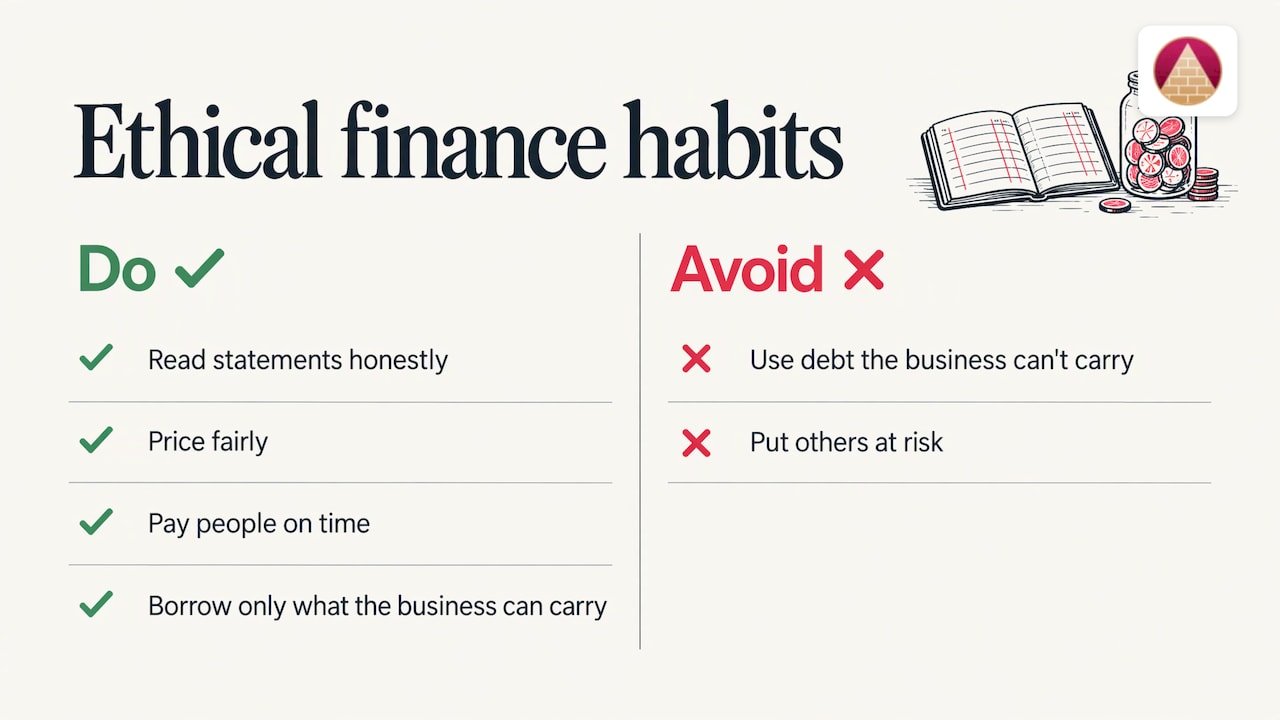
Numbers answer how a business is doing. They do not answer what the business is for. Leaders who want their companies to serve employees, customers and neighbors need both. That means reading statements honestly, pricing fairly, paying people on time and borrowing only what the business can carry without putting others at risk.
The habits above are the practical side of that character: realistic budgets, honest projections, reserves and responsible debt. They keep promises possible. Our own beliefs hold that wealth should serve the advancement of humanity rather than individual enrichment, and sound finances are what make that principle workable in a real business.
How membership supports your financial growth
Reading about ratios is one thing. Applying them with people who challenge your assumptions is another. Membership in our organization is built around guidance and support in financial growth, ethical leadership and political engagement, along with mentoring and access to elite networking events. Members also receive education in critical thinking and moral conduct, the habits that keep financial decisions honest under pressure.

If you are an entrepreneur or leader who wants to grow your finances in service of something larger than yourself, you can apply for membership through the registration page. You can also read more about the organization and its purpose first.
A 90-day plan to build the habit
You do not need a year to see results. Try this sequence:
- Days 1 to 30: get the facts straight. Separate personal and business accounts, catch up your records and produce a balance sheet and income statement. Calculate your breakeven point and monthly burn rate.
- Days 31 to 60: plan cash. Build a 13-week cash forecast. Set a reserve target of three to six months of operating costs and a monthly amount to reach it.
- Days 61 to 90: prepare for capital. Calculate your DSCR, list the funding options that match your needs and write a one-page summary of your financial position that a lender or partner could follow in two minutes.
Repeat the cycle each quarter. Financial literacy is a practice, and the owners who keep it up tend to see problems early, when they are still cheap to fix.
FAQ
Why is financial literacy important for an entrepreneur?
It shapes almost every decision a founder makes: pricing, hiring, borrowing and growth. The OECD finds that low financial literacy hinders access to finance and business sustainability. Owners who understand their numbers can also explain their business clearly to lenders and partners.
What are the main parts of financial literacy for a business owner?
A useful framework covers earning, spending, saving and investing, borrowing, and protecting. In practice that means knowing your margins and pricing, controlling costs, building reserves, matching debt to its purpose and carrying the right insurance. Reading the three core statements ties it all together.
How much cash reserve should a business keep?
America’s SBDC recommends an emergency fund of three to six months of operating costs. Divide your total monthly expenses by one and multiply by three to six to find your range. Choose the higher end if your revenue is seasonal or depends on a few customers.
Can I use the 50/30/20 rule for my business?
Use it for your personal finances, including the pay you take from the company. For the business itself, build the budget from your own categories, because revenue and costs are less predictable than a salary. Keep a reserve line in the budget every month.
Sources
- OECD/INFE Core Competencies Framework on Financial Literacy for MSMEs
- OECD: Financial Education for MSMEs and Potential Entrepreneurs
- OECD: Boosting financial literacy, Bridging the Finance Gap for Women Entrepreneurs
- OpenStax: Accounting Basics for Entrepreneurs
- OpenStax: Developing Startup Financial Statements and Projections
- SCORE Financial Management Workbook
- America’s SBDC: Mastering Financial Literacy
- SBA: Manage your business
- Harvard Business Publishing: A Guide to Creating Financial Statements for Entrepreneurs
- FDIC: Financial Management for a Small Business Participant Guide
- Craft3: The Definitive Guide to Getting Loan Ready
- FDIC: Money Smart for Small Business
- FDIC: Guide to Presenting Money Smart for Small Business
- SBA: MySBA Learning
- Citizens: The 50/30/20 Budget Rule
Pingback: Influence Without Authority: A Practical Guide for Leaders – ILLUMINATI