

Executive burnout is prolonged exhaustion, cynicism and a loss of perspective that comes from carrying decisions, people and expectations with too little recovery and too little honest support. It is treatable, and the evidence points the same way: leaders recover when they cut load, protect recovery time and stop carrying the role alone. This guide covers the signs, the causes, a recovery plan and prevention habits. It also shows why a circle of peers and mentors, which is what we build at the United Lodge, belongs in that plan.
TL;DR
- Burnout in leaders shows up as rising cynicism, lower energy, brain fog, fading motivation, negativity spilling into home life and a narrowing view of why the work matters.
- It is common at the top. In a 2022 study of healthcare executives, 33% of respondents scored in the high burnout range, and poor sleep and low self-valuation were tied to it.
- Recovery starts with less load, firm boundaries, protected rest and people who will tell you the truth. Severe burnout can take longer than a year to resolve.
- Persistent exhaustion, physical symptoms or signs of depression call for a doctor or mental health professional.
- Prevention works best when personal habits and the way the organization runs change together.
Table of Contents
- What executive burnout is, and what it is not
- Six warning signs worth taking seriously
- Why leaders burn out
- What burnout costs
- Executive burnout recovery: a practical sequence
- Managing executive stress day to day
- When to get professional help
- Preventing executive burnout in the long run
- Executive work-life balance without the slogans
- Where a community of peers fits
- FAQ
- Sources
What executive burnout is, and what it is not
Stress is pressure that eases when the pressure does. Burnout is what remains when the pressure has lasted too long and recovery never arrived. You can still function. You are just running on a reserve that has quietly run out.
For executives the pattern has a twist. Leaders tend to treat exhaustion as a character flaw, so they hide it, push harder and tell no one. Over time the work loses its meaning, and that loss of connection to purpose is often the most painful part.
Three things set executive burnout apart from a hard quarter:
- Duration. Rest does not fix it. A long weekend or a vacation brings only brief relief.
- Detachment. You stop caring about outcomes you used to care about, or you care and feel nothing.
- Spillover. It follows you into your family, your health and your judgment.
Six warning signs worth taking seriously
A 2026 article by Ramp and colleagues in the National Library of Medicine’s PMC archive lists six warning signs of leadership burnout:
- Growing cynicism, or difficulty staying professional with colleagues.
- Noticeably lower energy.
- Declining enthusiasm and motivation.
- Negativity that spills into your personal life.
- Brain fog.
- Losing perspective on the broader impact of your work.
A simple check: look at the last month and ask which of these you would not have recognized in yourself two years ago. Two or three that persist are a signal. Ask someone who knows you well too. Burnout dulls self-awareness, and a trusted peer often sees the change first.
Why leaders burn out
The conditions around the role
Australia’s Mental Health Commission published 2024 guidance for executives. It is a non-US source, but its findings fit leaders anywhere. It lists poor role clarity, unmanageable workload, unclear communication, a sense of too little support and unreasonable time pressure among the causes of burnout. It also reports that up to half of executives and decision-makers feel lonely, and 61% of them say loneliness hurts their job performance.
That isolation matters. At the top, the people who would normally listen are also the people your decisions affect. Many leaders end up with no one to think out loud with.
What the numbers show
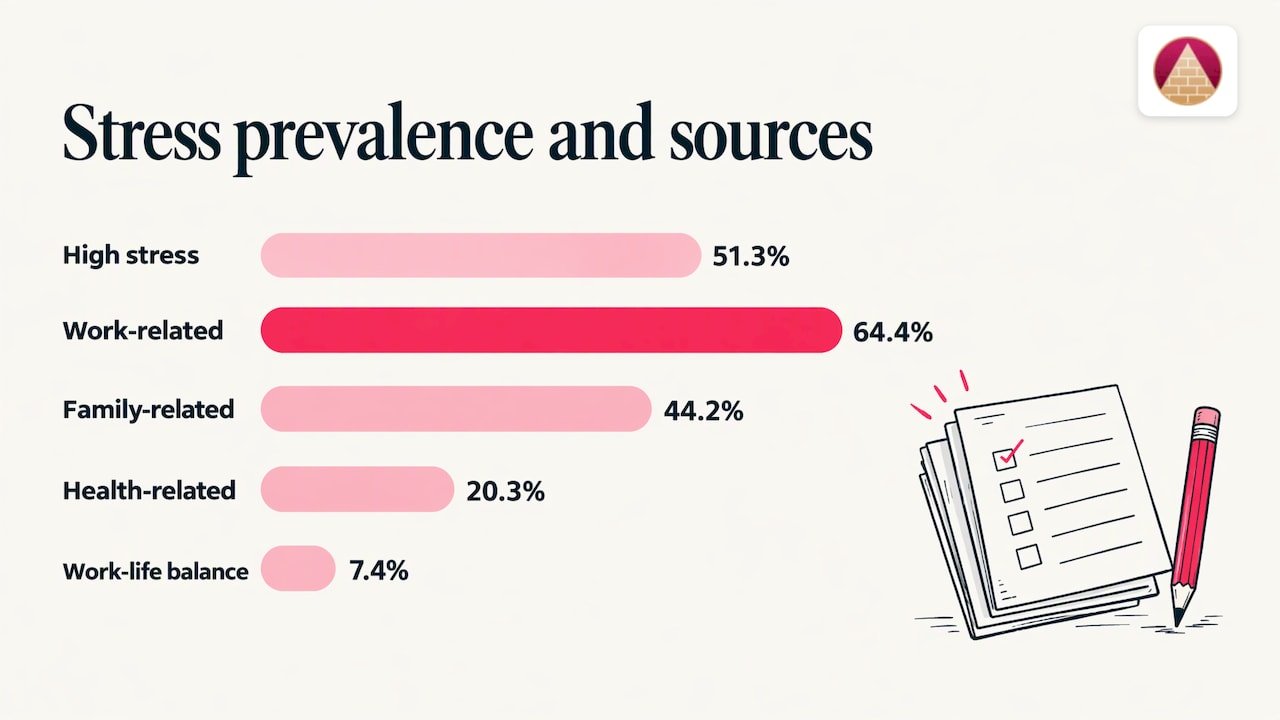
A peer-reviewed study of 839 executives in an executive health program found 51.3% reported high stress. The main sources were:
| Source of stress | Share of executives |
|---|---|
| Work-related | 64.4% |
| Family-related | 44.2% |
| Health-related | 20.3% |
| Work-life balance | 7.4% |
The study also found that anxiety was the strongest predictor of high stress (odds ratio 2.72), and that younger executives were more likely to report it.
The 2022 study of 1,269 members of the American College of Healthcare Executives, including 279 CEOs, found a mean burnout score of 2.71 on a 0 to 10 scale. One in three was in the high range. Two factors stood out. Each point of sleep-related impairment raised the odds of burnout by 29%, and each point of self-valuation lowered them by 37%. In plain terms, leaders who sleep badly and who judge themselves harshly are most at risk.
Personal patterns that feed it
The same authors describe a culture of “unforgiving excellence,” where self-criticism is constant and perfection is the standard. If you recognize yourself there, the answer is not lower standards. It is a commitment to excellence that allows for growth and for mistakes.
What burnout costs
Burnout touches health, decisions and relationships at once. Typical effects include chronic fatigue, headaches, chest tightness and palpitations, poorer concentration and a shorter fuse at home and at work. Because leaders set the tone, the damage travels. Researchers writing in 2026 describe how a leader’s emotional state can spread to a team through emotional contagion, and how psychologically safe teams raise problems early while threatened teams hide them.
There is a financial side too. A CEOWORLD Magazine report on 2025 cost modeling puts the toll of executive burnout at about $20,683 per executive each year. Treat that as a modeled estimate, not a measurement. It still shows that burnout is a business problem as much as a personal one.
Executive burnout recovery: a practical sequence
Recovery is slower than most leaders expect. Medical News Today, citing a 2021 clinical perspective paper, notes that many people with short-term stress recover within a few months, while severe burnout can take longer than a year, and some people had not fully recovered after four years. Plan for a long arc and judge progress by direction, not by a deadline.
Step 1: Name it and say it out loud
Tell one person you trust that you are struggling. The leadership-burnout authors argue that openly saying “I don’t know” or “I am struggling” models authenticity and builds team resilience. This step fails when you wait until you are sure it is “bad enough.” Say it early.
Step 2: Reduce the load
Decide what you will delegate, defer or drop. The same authors advise leaders to set boundaries by choosing what to hand off. Medical News Today also lists working less as a core recovery strategy. This step fails when you delegate tasks but keep the worry. Hand over the decision and the outcome, not just the work.
Step 3: Protect recovery time on the calendar
Block recovery time and avoid back-to-back meetings. Give your time to intentional activities, such as walking the floor or holding one-on-one conversations that build trust and cut down on endless email. A boundary that is not on the calendar does not exist.
Step 4: Rebuild sleep
Sleep-related impairment was one of the two factors independently linked to burnout among healthcare CEOs. Treat sleep as a performance and health issue, not a luxury. If you cannot sleep for weeks, raise it with your doctor.
Step 5: Work on the inner critic
Low self-valuation was linked to higher burnout. Cognitive restructuring, one of the strategies Medical News Today recommends, means catching the harsh thought, testing it against the facts and replacing it with a fairer one. A mental health professional can guide this work.
Step 6: Build your support layer
The CEOWORLD piece recommends a three-layer support stack: a peer forum, a coach or therapist, and an internal truth-teller. The peer layer is where many leaders have a gap, because the people at your level are rarely the ones you see on an ordinary day. A standing group of peers who share your responsibilities and your values, and who will tell you plainly what they see, is one of the most direct answers to the loneliness the research describes.
Step 7: Start relapse prevention before you feel better
Do not wait for full recovery before building the habits that keep you well. Keep the calendar blocks, the sleep routine and the check-ins running as you improve. Burnout tends to return to people who go straight back to the old pace.
Managing executive stress day to day
Burnout recovery is a long project. Stress management is the daily maintenance that stops you from needing it. A few habits with evidence behind them:
- Reduce decision load. Set standing rules for recurring choices so your best judgment goes to the decisions that matter.
- Run a quarterly workload reset. Review what is on your plate, what has grown quietly and what can go.
- Honor a hard stop. Midnight emails teach your team that midnight emails are expected. Leaders model the behavior they say they do not want.
- Track your own signals. Sleep, irritability, energy and enthusiasm are early indicators. Note them weekly.
- Accept uncertainty. The leadership-burnout authors suggest embracing discomfort with uncertainty rather than trying to remove it.
If you have an organization behind you, add one more: train managers to spot early signs of overload, so you are not the only warning system.
When to get professional help
Self-management has limits. Medical News Today advises seeking support when your usual coping no longer helps, exhaustion continues despite rest, stress shows up as physical symptoms, or you notice signs of clinical depression. A doctor or mental health professional can assess you and refer you onward.
If you ever have thoughts of harming yourself, call or text 988, the Suicide and Crisis Lifeline in the United States, or contact emergency services. Chest pain or palpitations should be checked by a doctor promptly, not assumed to be stress.
Preventing executive burnout in the long run
A 2025 systematic review and meta-analysis of 25 studies with 2,466 participants found that stress management programs aimed at leaders had significant effects on mental health (g = -0.38), work-related outcomes (g = -0.32) and leadership-related outcomes (g = -0.23). The negative signs reflect reduced strain. The effects were modest to moderate, which fits what leaders report: no single tactic solves it, and a mix works.
A 2026 perspective in PMC argues that burnout cannot be handled through isolated well-being measures or individual coping alone. It points to structural targets aligned with World Health Organization guidance:
- Flexible working arrangements
- Workload management
- Worker participation and autonomy
- Clear role definition
- Mental-health training for managers
- Anti-harassment policies
- Equitable recognition
- Structured return-to-work programs
If you run a company, that list is your agenda. If you are an entrepreneur with a small team, pick two and start there. Clear roles and a workable load come first.
Executive work-life balance without the slogans
Balance is rarely an even split of hours. For most leaders it means that the things you value most get protected time, and that work does not claim the rest by default. In the executive health study above, work-life balance was named as a main stressor by only 7.4% of executives, while family-related stress was named by 44.2%. That suggests the question is less about hours and more about whether your relationships and health get your attention when you are present.
Try this: pick three non-negotiables each week, one for health, one for family or close friends and one for yourself. Put them in your calendar first, then let work fill what remains.
Where a community of peers fits
Loneliness, a lack of honest feedback and a drift from purpose are the threads that run through the research. We built the United Lodge as an answer to that part of the problem. Membership gives leaders, entrepreneurs and people committed to ethical leadership a community built on mutual respect, with mentoring, education in critical thinking and moral conduct, and access to networking events. Our approach rests on the principle that wealth and influence should serve the advancement of humanity, which gives many leaders back the sense of purpose that burnout takes away.
You can read what we stand for on our beliefs page and our purpose page. If you are ready to join a circle of peers, you can apply for membership.

Membership is a complement to medical care and professional treatment, not a replacement. If you are experiencing the symptoms described above, speak with your doctor first.
FAQ
How do I know if I have executive burnout or just stress?
Stress usually eases when the pressure does. Burnout persists after rest and shows up as cynicism, low energy, brain fog, fading motivation and a loss of perspective on why your work matters. If several of these have lasted for weeks and are affecting your home life, treat it as burnout and act.
How long does executive burnout recovery take?
It varies widely. Many people with short-term stress recover within a few months, while severe burnout can take more than a year, and some people have not fully recovered after four years, according to Medical News Today’s review of the research. Cutting workload, protecting sleep and building support all shorten the road.
What is the fastest way to manage executive stress this week?
Block two recovery windows on your calendar, avoid back-to-back meetings, and set a hard stop that you honor. Delegate one decision you have been holding. Then tell one trusted person how you are really doing.
Can organizations prevent burnout among their leaders?
Yes, though it takes structural change. Research points to clear roles, manageable workloads, flexible working, manager training and psychologically safe teams, as outlined in a 2026 PMC review. Individual habits matter, but they work best alongside these changes.
When should an executive see a doctor about burnout?
See a doctor or mental health professional when rest no longer helps, when stress causes physical symptoms such as chest pain or palpitations, or when you notice signs of depression. Do not wait for a crisis. In an emergency, call 988 or your local emergency number.
Sources
- Leadership Burnout: Urging Leaders to “Put Their Oxygen Mask on First” (PMC, 2026)
- A mentally healthy workplace for executives and decision-makers (Australian Mental Health Commission, 2024)
- The Stressed Executive: Sources and Predictors of Stress (PMC)
- Assessing Professional Fulfillment and Burnout Among CEOs (PMC, 2022)
- Leadership, burnout, and organizational mental health (PMC, 2026)
- Effectiveness of leader-targeted stress management interventions (PMC, 2025)
- Five Things CEOs Can Do to Reduce Stress in the Workplace (CEOWORLD Magazine, 2026)
- How to recover from burnout (Medical News Today, 2023)
- Preventing burnout: 7 strategies and when to seek help (Medical News Today, 2023)